

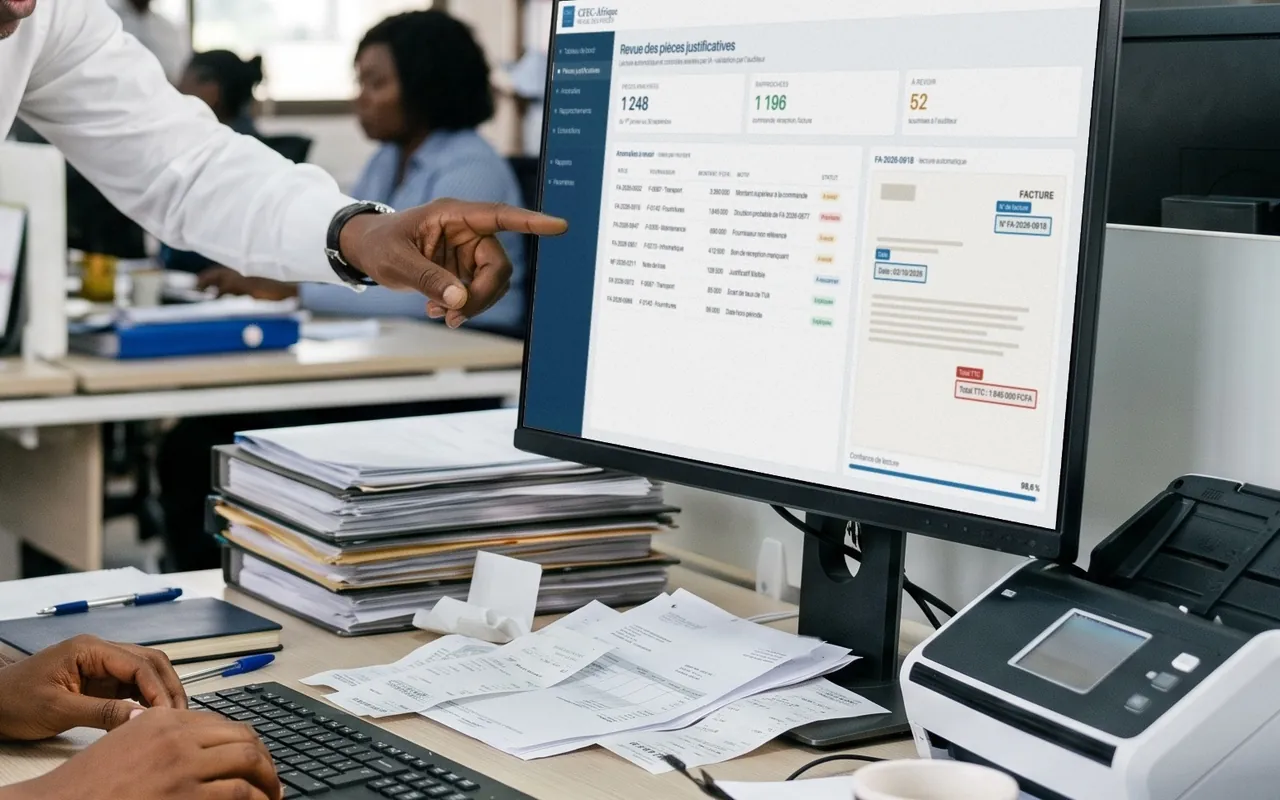
Much financial information circulates as documents: supplier invoices, bank statements, delivery notes, contracts, scanned supporting documents and e-mails. We design processing chains that read these documents, extract the useful data, check it and organise it in tables or databases. The structured data then feeds your accounts, reconciliations and analyses without re-keying.
From document to data
Reading documents
Optical character recognition (OCR) and artificial intelligence models suited to documents in French and English, including scans of uneven quality.
Field extraction
Supplier, tax identification number, dates, amounts before and after tax, VAT, line items, order references.
Checks
Matching with purchase orders and receipts, duplicate detection, tax calculation checks; doubtful documents are flagged for review.
Structuring and integration
Data organised according to a defined model, linked to the source document and passed to your ERP, accounting software or database.
What we do
- Inventory of the documents received and produced: types, volumes, formats and workflows.
- Scanning and preparation of the paper archives to be processed.
- Automated extraction of data from invoices, bank statements, payslips, contracts and forms.
- Automated reconciliations: bank statements and accounts, invoices and orders, stock counts and registers.
- Building structured datasets from existing archives, for an audit, a migration or an analysis.
- Integration of the extracted data into your ERP or accounting software.
- Human review of doubtful cases and measurement of extraction quality.
Our approach
Inventory
We identify the documents, the information to extract and the intended use of the data.
Configure
Reading models and control rules are tuned on a sample of your documents.
Validate
Results are compared with a reference entry; error rates are measured before go-live.
Operate
The chain processes new documents; doubtful cases are referred to your teams.
Reports and deliverables
- Model of the data to extract and control rules.
- Processing chain in production, with its user guide.
- Structured datasets linked to the source documents.
- Quality report: measured recognition and error rates.
